Seen in Google Reader:

I’m not even going to start enumerating ways in which this ad is ironic.
Seen in Google Reader: I’m not even going to start enumerating ways in which this ad is ironic.
Seen in Google Reader:
I’m not even going to start enumerating ways in which this ad is ironic.
… when I read my blogs. Does anyone know why?
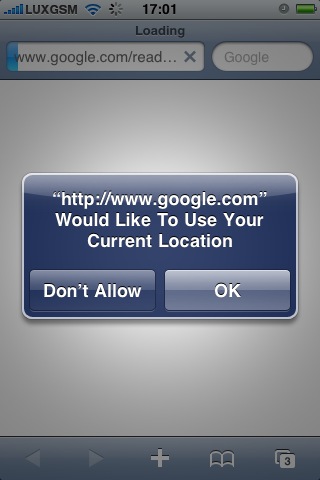
… when I read my blogs. Does anyone know why?
Luxembourg’s grand-ducal palace originally was its city hall. Therefore, it’s actually a rather small building – particularly tangible during the guided tours that it’s open for during summer. Unfortunately, no photography is allowed inside. (Repo…

Luxembourg’s grand-ducal palace originally was its city hall. Therefore, it’s actually a rather small building – particularly tangible during the guided tours that it’s open for during summer. Unfortunately, no photography is allowed inside.
(Reposting with fixed white balance.)
Via BoingBoing comes a pointer to an article on Ed Fredkin in the April 1988 issue of The Atlantic. Fredkin’s argument, in a nutshell: If physics can be described as a cellular automaton (with a rule that turns into the first mover), then the univ…
Via BoingBoing comes a pointer to an article on Ed Fredkin in the April 1988 issue of The Atlantic.
Fredkin’s argument, in a nutshell: If physics can be described as a cellular automaton (with a rule that turns into the first mover), then the universe might very well just be that guy running a simulation somewhere, to answer a question about a cellular automaton that he can’t answer, except by running the machine.
But what does “might be” mean here? Is the universe a cellular automaton running on a computer or can it just be described as one? That’s where the article’s author, Robert Wright, gets uncomfortable.
Around sundown on Fredkin’s island all kinds of insects start chirping or buzzing or whirring. Meanwhile, the wind chimes hanging just outside the back door are tinkling with methodical randomness. All this music is eerie and vaguely mystical. And so, increasingly, is the conversation. It is one of those moments when the context you’ve constructed falls apart, and gives way to a new, considerably stranger one. The old context in this case was that Fredkin is an iconoclastic thinker who believes that space and time are discrete, that the laws of the universe are algorithmic, and that the universe works according to the same principles as a computer (he uses this very phrasing in his most circumspect moments). The new context is that Fredkin believes that the universe is very literally a computer and that it is being used by someone, or something, to solve a problem. It sounds like a good-news/bad-news joke: the good news is that our lives have purpose; the bad news is that their purpose is to help some remote hacker estimate pi to nine jillion decimal places.
Parting thought: Does it even matter, to someone who can be described as a pattern in that cellular automaton?
Centralized URI shorteners have every possible risk of being slashdotted (or overtweeted, you choose) — they effectively add another layer of centralized infrastructure that can then run out of resources. Put differently, URI shortener infrastruc…

Centralized URI shorteners have every possible risk of being slashdotted (or overtweeted, you choose) — they effectively add another layer of centralized infrastructure that can then run out of resources. Put differently, URI shortener infrastructure seems to scale differently than twitter’s, and the result isn’t always funny.
(Today, David Weinberger’s pointer about Lego and the cluetrain was the victim.)
Today’s weather looks just about right for the occasion: The Perseids meteor shower is expected to peak tonight. The forecast: Occasional rain, and solid clouds.

Today’s weather looks just about right for the occasion: The Perseids meteor shower is expected to peak tonight. The forecast: Occasional rain, and solid clouds.
One of the amazing things in a small village nearby is this flower bed, with a large sign inviting passers-by to cut their own. There’s a price list and a little box for the coins. That’s it. I don’t know whether it all ends up making economic sen…


One of the amazing things in a small village nearby is this flower bed, with a large sign inviting passers-by to cut their own. There’s a price list and a little box for the coins. That’s it. I don’t know whether it all ends up making economic sense for the owners. But it’s certainly a view to behold.
August is slow season at work, so some time to take photos: I spent this Friday taking entirely too many snaps, partially of the Place de l’Europe (pictured here), and partially of I M Pei’s Mus??e d’Art Moderne. Go have a look!

August is slow season at work, so some time to take photos: I spent this Friday taking entirely too many snaps, partially of the Place de l’Europe (pictured here), and partially of I M Pei’s Musée d’Art Moderne. Go have a look!
I’ve been on dopplr for quite a while and found it fun and useful. After some raving notes on Twitter, I decided to give TripIt a spin. Where dopplr’s claim to fame is the social networking aspect, TripIt’s is that it’s a really nice tool to manag…
I’ve been on dopplr for quite a while and found it fun and useful. After some raving notes on Twitter, I decided to give TripIt a spin.Where dopplr’s claim to fame is the social networking aspect, TripIt’s is that it’s a really nice tool to manage information: Take an itinerary (or a hotel booking confirmation), send it to TripIt, and all that important information will be extracted. You can then subscribe your calendar to it, or access your account through a relatively nifty iPhone application. No more searching for that hotel address when you arrive at an airport — quite useful indeed, information at one’s fingertips. It appears like you can also manage your entire meeting schedule during a trip through the application, though I haven’t tried that.Interestingly, TripIt’s strengths don’t really seem to be on the social networking side. Case in point, dopplr (like facebook) actively encourages finding friends and colleagues to share one’s data with. TripIt lets its users walk their social network, and it lets them invite others by e-mail address — but nothing in between (like a search by name).Want to manage your flight data and hotel stays, and have a backup of all that travel information in the cloud? Go for TripIt.Want restaurant recommendations or city guide pages that are built by the users? Better stay with Dopplr.Fortunately, though, it’s possible to combine TripIt’s information management with Dopplr’s social networking strengths: You can subscribe your dopplr account to the calendar feed made available by TripIt. The result: Dopplr gets the page views, TripIt does some of the grunt work till Dopplr catches up on that.I’m having a hunch whose business model is going to survive better.PS: I won’t spend time expanding my network on tripit — the one on dopplr is larger, I don’t want to rebuild it, and it isn’t too useful for the things I’ll use TripIt for.
Keeping historical documents around is hard, as my native city of Cologne painfully experienced a few weeks ago, when the city archive collapsed. But it’s also hard on the web. Case in point, a number of important early specifications for the Web …
Keeping historical documents around is hard, as my native city of Cologne painfully experienced a few weeks ago, when the city archive collapsed.But it’s also hard on the web. Case in point, a number of important early specifications for the Web (like pre-standard SSL, or the original Cookie spec) have traditionally been sitting at netscape.com URIs. Unfortunately, AOL seems to have pulled these pages around the time they disbanded the remains of Netscape.While the wayback machine helps us out this time, one would wish that organizations that acquire historically important technology spent more effort preserving the documents they have. With the consolidation that the economic crisis will bring, I fear that this hasn’t been the last time that these kinds of historical documents disappear from their canonical location.
 No Such Weblog