GNSO update: WHOIS Task Forces; Council.

Looking at Bret’s latest insights into the kind of input the IPC (but not just the IPC) is getting from the public, one may be lead to believe that nothing goes on at ICANN. That’s not precisely accurate, as far as the GNSO is concerned — the las…
Looking at Bret’s latest insights into the kind of input the IPC (but not just the IPC) is getting from the public, one may be lead to believe that nothing goes on at ICANN. That’s not precisely accurate, as far as the GNSO is concerned — the last couple of weeks have been busy with conference calls.WHOIS task forces #1 and #2 (access mechanisms, review of data elements collected and displayed; I’m a liaison to both, but currently focusing on #2) have been busy figuring out what kinds of questions need to be asked in order to gather the input people believe they need for an informed discussion; I understand that task force #3 (accuracy) is going through a similar exercise. Fortunately, none of the task forces is going to repeat the large-scale survey exercise of the DNSO’s WHOIS Task Force. Instead, the plan is to tap GNSO constituencies and other specific sources of information. ICANN staff is expected to compile the input received before the Rome meetings. In Rome, there will be workshops for all three WHOIS PDPs. Constituency statements are then expected to arrive some time after Rome, with policy recommendations ideally ready by the time of the Kuala Lumpur meetings this summer.The GNSO council is working on the new registry services PDP. On last Thursday’s call, the council first discussed the business constituency’s request to remove two “out of scope” items from the Terms of Reference for that PDP. From the discussion, it didn’t become clear whether the BC was suggesting that the PDP should actually create a new consensus policy (that would be binding for registries, and would surely be highly contentious), or whether the BC was mis-reading the limits on the scopes of the PDP as limits on the scope of the process that is being designed. The discussion was settled by leaving the terms of reference unchanged, and by noting that the BC may, of course, include “additional remarks” with its constituency statement.Speaking of constituency statements, these were due on 12 January. Among the statements received so far, the registry constituency is still missing in action, some other constituencies have only posted draft statements. The statements were briefly presented on the council call, and ICANN staff was asked to produce a summary and identify areas of convergence or divergence as far as visible from the current statements. I understand that the new registry services PDP will be the topic of another workshop in Rome.The work that is going on on the four PDPs means that the GNSO is collecting a lot of experience with the new PDP. If anything is clear by now, then it’s that the time lines outlined in the new bylaws were the product of wishful thinking: Task Forces that have to gather input in order to produce results (like all of the whois task forces) have no chance at all to meet the deadlines suggested. And even council-driven policy-development processes that “only” involve deliberation within constituencies, and between constituencies (like the new registry services process), are not able to follow the process: According to the original announcement of the new registry services PDP, results were due on January 15.

Joe job.

It seems that some criminal is using my e-mail address, roessler@does-not-exist.org, as a sender address for (so far) body-part enlargement spam; typically, my address shows up both as the envelope sender, and in the From header of the messages in…

It seems that some criminal is using my e-mail address, roessler@does-not-exist.org, as a sender address for (so far) body-part enlargement spam; typically, my address shows up both as the envelope sender, and in the From header of the messages in question. I’m, of course, not involved with that — I’m just getting the bounces.Things are, so far, on a much smaller scale than what happened to others, but it’s still annoying. I’m not planning to change either my domain name, or my e-mail address; bounce messages that were not generated in response to messages I sent are discarded automatically.

k now has an instance in Frankfurt.

Heise reports (in German) that a new instance of k.root-servers.net has gone life in Frankfurt.

Heise reports (in German) that a new instance of k.root-servers.net has gone life in Frankfurt.

ALAC on new registry services

I’ve just sent ALAC’s preliminary remarks on the new registry services PDP to the GNSO Council. The remarks are “preliminary” because we solicit public comment and further input on these; we will make sure that comments we get are heared by the GNSO.

I’ve just sent ALAC’s preliminary remarks on the new registry services PDP to the GNSO Council. The remarks are “preliminary” because we solicit public comment and further input on these; we will make sure that comments we get are heared by the GNSO.

Please remove these games.

At work, I share my office with our systems administrator. Enters a colleague, puts on her sweetest “I neeed computer support” smile. “Hi, you’ve got this ‘my computer does something I don’t want it to do’ expression in your face.” — “Errm, well,…

At work, I share my office with our systems administrator. Enters a colleague, puts on her sweetest “I neeed computer support” smile. “Hi, you’ve got this ‘my computer does something I don’t want it to do’ expression in your face.” — “Errm, well, couldn’t you remove the games from my computer? They are, well, preventing me from getting my work done. I mean, it would be nice if you could remove them, but it’s not that urgent. Oh, by the way, the games that come with Fedora are not as good as the ones with the previous Redhat.”

sitefinder.verisign.com: NXDOMAIN.

Since last week-end, sitefinder.verisign.com (the search engine to which the wildcard redirected) no longer resolves. The final nail in the coffin, or the first step towards re-branding and re-launching?

Since last week-end, sitefinder.verisign.com (the search engine to which the wildcard redirected) no longer resolves. The final nail in the coffin, or the first step towards re-branding and re-launching?

Media_httplogdoesnote_fxbfg

Habeas spam.

Habeas attempts to fight spam with haikus: The theory is that whoever puts a habeas header into e-mail without having received a license gets sued by the corporation. Unfortunately, most of the spam that currently gets past my spam filter has the …

Habeas attempts to fight spam with haikus: The theory is that whoever puts a habeas header into e-mail without having received a license gets sued by the corporation. Unfortunately, most of the spam that currently gets past my spam filter has the magical haiku — and, even worse, is autolearned as “ham” by spamassassin.

score HABEAS_SWE -1.0

GNSO: 3 council members per constituency.

ICANN has published proposed corrections to the bylaws, to be considered by the board on 15 January 2004. These corrections change the number of council members per constituency back from two (as suggested by the reformed bylaws, but never impleme…

ICANN has published proposed corrections to the bylaws, to be considered by the board on 15 January 2004. These corrections change the number of council members per constituency back from two (as suggested by the reformed bylaws, but never implemented) to three (as favored by the majority of the council, and accepted by the board in Carthage) until the 2004 annual meeting.It’s worth noting that the change as drafted seems to need a correction: The terms suggested (2 reps until 2005, 1 rep until 2004, two-year terms from 2005) do not lead to the staggered terms for council members that are mentioned elsewhere in the bylaws — unless there is another board decision that removes the 2004 sunset date on the three representative scheme.

A photo blog.

So I finally couldn’t resist: Keine Photos bitte (“no photos please”) is where I’m posting the occasional picture. The text that comes with the photos will be in German.

So I finally couldn’t resist: Keine Photos bitte (“no photos please”) is where I’m posting the occasional picture. The text that comes with the photos will be in German.

Esther Dyson on The Accountable Net.

Writes Esther Dyson in the New York Times (link credit: Bret Fausett): What I’m proposing is not a rule-free society, but one in which rules come from the bottom up: generally enforced by peers, with governments in the background. … The basic ru…

Media_httplogdoesnote_untba

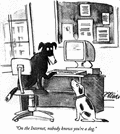
Writes Esther Dyson in the New York Times (link credit: Bret Fausett): What I’m proposing is not a rule-free society, but one in which rules come from the bottom up: generally enforced by peers, with governments in the background. … The basic rule is transparency: You need to know whom you are dealing with, or be able to take proper measures to protect yourself.Unfortunately, the article essentially sets up anonymity and accountability online as contradictions. They need not be: The kind of accountability Esther describes is not so much about knowing who someone is in real life, but rather about recognizing a party you are dealing with (or knowing that you don’t recognize a party seeking to communicate with you, and taking appropriate action). It’s, often, not so much about linking on-line activity to real lilfe, but more often about linking current on-line activity to past on-line activity — and, by symmetry, linking future on-line activity to current on-line activity.This is so because for many activities online, stakes are actually quite low: To decide who’s messages to read on mailing lists, or blogs, or slashdot — or, in the past, Usenet –, for instance, it may quite well be enough to know that source’s reputation among peers, or to have read earlier messages from that source. If something goes wrong, only littlel damage is done. All one needs to know to make this kind of choice is a regularly-used online pseudonym (most often, that’s the e-mail address these days). If the same person uses a different pseudonym elsewhere, that’s their business.(Where the stakes are higher, reliable links to a person’s online existence are, of course, useful.)Accountability online is not a binary choice between total anonymity on the one hand, and total transparency with links to real life on the other: There is a broad spectrum between these, and often, the level of transparency and accountability that’s needed will lie somewhere in between.As a side note, all the accountability you can get won’t fix viruses and similar security intrusions, unlike what Esther suggests: Just like the ordinary flu, successful online viruses often travel along the links in social networks.