
Online work styles: Low latency required?

I spent the last week-end touring Crete, and the subsequent week in meetings in beautiful Agia Pelagia. While everybody was longing for the breaks and evenings (you just can’t not go for a swim there), a lot of us were fighting with Internet acces…

Media_httpfarm2static_nwabw

I spent the last week-end touring Crete, and the subsequent week in meetings in beautiful Agia Pelagia. While everybody was longing for the breaks and evenings (you just can’t not go for a swim there), a lot of us were fighting with Internet access: While nominally high-speed access was available in a number of places, the latency often turned out to be a killer. Using skype for a telephone conference (which I do pretty regularly while traveling) turned into a disaster, both concerning sound quality and latency; I did more than one conference call from my mobile, which I normally avoid like the plague for these things. Doing work on CVS was annoying and made focusing hard, since any update or commit would take ages. Going through list archives was almost impossible.In the end of the day, I was much less effective getting my usual work done than I normally am while traveling. Without me having noticed before, my work style had become dependent not just upon having some Internet access, but upon having low-latency Internet access. I was surprised myself how badly I function in asynchronous mode these days.I wonder if that’s just how my personal work style evolved, or whether it’s a more general effect? How do others deal with work in high-latency environments with spotty Internet access?
Transparently insane?

Via flyertalk, this story about a transparent bag mandate outside an airport context: Wissahickon Students Face Strict Backpack Rules High School students in the Ambler, Pennsylvania, headed back to school Tuesday facing new security measures limi…

Via flyertalk, this story about a transparent bag mandate outside an airport context: Wissahickon Students Face Strict Backpack Rules

High School students in the Ambler, Pennsylvania, headed back to school Tuesday facing new security measures limiting their choice of backpacks. Effective Tuesday, all students in the Wissahickon School District are required to carry clear bags. Students are currently permitted to bring mesh backpacks to school, but once inside the building, they must change to a clear backpack. … Wissahickon is the third high school in Montgomery County to adopt clear backpacks.

OpenID over WS-Trust?

In an interesting example of how the different identity systems around play together (or not), SXIP has proposed an “OpenID infocards” spec. Allegedly, there is a working implementation around; I haven’t tried it, though. OpenID Information Cards …

In an interesting example of how the different identity systems around play together (or not), SXIP has proposed an “OpenID infocards” spec. Allegedly, there is a working implementation around; I haven’t tried it, though.

OpenID Information Cards 1.0 – Draft 01
D. Hardt, J. Bufu
Sxip Identity
August 10, 2007

“Infocards” in this context effectively means “OpenID over WS-Trust.” Painting with a broad brush, this specification essentially takes OpenID’s colon-separated-tag-value assertion format and embeds it with WS-Trust.Signalling that a relying party supports this protocol variant is not interoperable with the signalling used traditionally in OpenID.An OpenId infocards relying party needs to understand an additional — though quite lightweight — protocol exchange which wraps the OpenId token into token XML pointy brackets, to Paul Madsen’s immense delight.An OpenId infocards provider needs to implement a WS-Trust Security Token Service.The protocol interchanges are not interoperable with the ones traditionally used in OpenID: Steps 1-6 of the OpenID protocol are replaced with WS-Trust based interactions. Step 7, in its “direct verification” variant, remains in place, and ensures that the identity (still a URI) remains bound to the overall transaction.Conversely, there are similar implications for Infocard enabled services that would want to support this scheme; for them, the OpenID infocards spec effectively introduces yet another token format. See Eric Norman’s blog.On its face, this proposal suggests splitting the OpenID protocol into two not mutually interoperable variants, one fitting into Microsoft’s cardspace framework, and one having all the lightweight RESTful karma that makes OpenID interesting to the parts of the Web community that are less than fond of WS-*. The URL as an identity paradigm is much less central to this variant of OpenID than to the classical one: For much of the protocol exchange, what matters is the endpoint that serves as the Security Token Service. The “identity” URL itself only ever plays a role in the final verification step.All this points to interesting times ahead, as the various camps in identity space will continue to perform tangled dances.

Flying While Arabic

From the San Diego Metro News: An American Airlines flight from Lindbergh Field to Chicago was delayed overnight Tuesday because of a passenger’s fright over some Arabic-speaking men on board. The story itself is fairly surreal — a bunch of men w…

From the San Diego Metro News:

An American Airlines flight from Lindbergh Field to Chicago was delayed overnight Tuesday because of a passenger’s fright over some Arabic-speaking men on board.

The story itself is fairly surreal — a bunch of men were talking in a language that sounded like (and apparently was) Arabic, some other passengers got hysteric about terrorism for no good reason, and the plane returned to the gate.Some of the comments make for even more ghastly reading, and justify racist hysteria with the “better safe than sorry”, “think of the children”, “we’re at war” school of argument.One thing is for sure: I wouldn’t want to sit in the same plane as these commenters.Later: Yesterday’s BoingBoing piece on how people react to fear of death — in particular as their political views are concerned — relates to this story in an interesting way. Go read it.

Trying the gods of air travel

Seems I was trying the gods of air travel when I wrote: For example, it might seem surprising that an airline like Luxair (which does pretty much exclusively point-to-point traffic between Luxembourg and the rest of Europe, plus some holiday desti…

Seems I was trying the gods of air travel when I wrote: For example, it might seem surprising that an airline like Luxair (which does pretty much exclusively point-to-point traffic between Luxembourg and the rest of Europe, plus some holiday destinations, and should therefore have very little lost or delayed luggage) ends up on place 19 (losing 17.7 pieces of luggage) for the second quarter, and so on.While I was on a direct flight with them this morning, my luggage was not — or at least not on the same one. And that after early check-in, in Vienna…Later: Seems like I shouldn’t blame on Vienna what can be explained by sloppiness here. The suitcase “appeared” two or three hours later at the airport, and was then delivered. The tag on it suggests that it didn’t see any planes except for the flight from Vienna to Luxembourg that I was on, too.

The ICANN WHOIS Saga

Over at IGP Blog, Milton Mueller has posted a WHOIS timeline, which indeed makes for a nice presentation of the institutional drama that ICANN has seen over the years, and that I spent more time on that I’d ever want to be reminded of. The timelin…

Over at IGP Blog, Milton Mueller has posted a WHOIS timeline, which indeed makes for a nice presentation of the institutional drama that ICANN has seen over the years, and that I spent more time on that I’d ever want to be reminded of.The timeline gets a bit fuzzy on the facts, however, when it comes to the 2003 and 2004 events.

From the anti-spam toolbox: Greylisting.

Greylisting is the idea to reject incoming messages with an SMTP error code that indicates failure, unless the source of the message has sent e-mail to the given recipient before (or some other heuristic for “we’ve seen that source before”). The o…

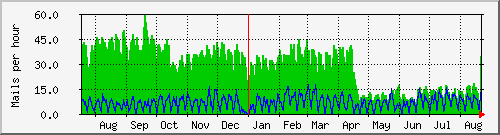
Greylisting is the idea to reject incoming messages with an SMTP error code that indicates failure, unless the source of the message has sent e-mail to the given recipient before (or some other heuristic for “we’ve seen that source before”). The observation underlying this scheme is that e-mail has traditionally been a store-and-forward medium able to deal extremely well with all kinds of temporary glitches. Ordinary mail servers will just queue up a message when they get “greylisted”, and try again after a while (and again), at which point the message will be accepted. The SMTP implementations used by spammers, however, seem to commonly just fail when they encounter any kind of SMTP error.

Media_httplogdoesnote_bodzk

The statistics show that greylisting (I’m using postgrey) has been removing a significant part of my incoming spam burden; the green curve represents the spam and other junk detected on my personal mail server, the blue curve represents the messages that get through (still including a significant amount of spam, most of which is caught by a bogofilter installation on my laptop).Of course, greylisting has one significant weakness: It will only work as long as it makes an insignificant dent into spammers’ output (as opposed to just some sites’ input). As soon as the technique becomes widespread enough to become noticeable for spammers’ returns, we’ll start to see SMTP implementations for spammers that implement some kind of retry mechanism. Until that happens, however, greylisting is a truly useful tool.

Creative Commons Luxembourg: Launch on 15 October

The Creative Commons licenses come to Luxembourg: There will be a launch event on 15 October, at the Public Research Center Henri Tudor on Kirchberg. Speakers will include Patrick Peiffer (the driving force behind Luxcommons, and also involved wit…

The Creative Commons licenses come to Luxembourg: There will be a launch event on 15 October, at the Public Research Center Henri Tudor on Kirchberg.Speakers will include Patrick Peiffer (the driving force behind Luxcommons, and also involved with the CC-licensed Luxembourgensia collection at the National Library), John Buckmann (Magnatune founder), and Laurent Kratz (Jamendo founder).And for the Web 2.0 crowd: It’s on upcoming as well.

Baggage loss statistics

If you wonder why your baggage got lost this time, then the Association of European Airlines is a good source, with its statistics about punctuality, lost luggage, and a timeline of events. In their consumer report for the second quarter (found on…

If you wonder why your baggage got lost this time, then the Association of European Airlines is a good source, with its statistics about punctuality, lost luggage, and a timeline of events. In their consumer report for the second quarter (found on flyertalk) , the number of times that Heathrow’s baggage system simply broke down — independently of any well-known external difficulties such as terrorist attacks — is striking, and scary.Unsurprisingly, British Airways ends up on the last place (23 out of 23) in the baggage handling discipline, “delaying” 28 pieces of checked baggage per 1,000 passengers. To put that number into perspective and see just how far an outlier it is, Swiss was on place 10 (losing 10 pieces per 1,000 passengers), Lufthansa on place 16 (losing 16 pieces per 1,000 passengers — the European average), Air France on place 18 (losing 16.3 pieces), and KLM on place 21 (losing 17.8 pieces). In the first quarter, BA had performed slightly less miserable (place 23 out of then 24, and ahead of TAP which is place 22 in the second quarter), losing “just” 24.7 pieces per 1,000 passengers, without any reported baggage system failures at Heathrow.Note that, when comparing lost baggage numbers, some care is needed: missing baggage reports are taken by the last airline in a chain of connections. Yet, I’m guessing that numbers for the likes of BA, LH, AF and their recent acquisitions are roughly measuring the same kind of experiment, given that all these airlines have lots of connections and large networks.On the other hand, numbers for some other, smaller airlines are likely to be distorted heavily, and don’t lend themselves to an easy comparison. For example, it might seem surprising that an airline like Luxair (which does pretty much exclusively point-to-point traffic between Luxembourg and the rest of Europe, plus some holiday destinations, and should therefore have very little lost or delayed luggage) ends up on place 19 (losing 17.7 pieces of luggage) for the second quarter — but then again, they provide feeder services for Lufthansa in Frankfurt and Munich, for BA (and others) in Heathrow, and for Air France at Charles de Gaulle.

Architectures of Control: Heathrow.

Tim Bray recommends to Avoid Heathrow At All Costs — indeed a good idea, and there’s also a lot of amusing commentary to be read there. One of the more interesting comments points to Architectures of Control, which discusses how designs of buildi…

Tim Bray recommends to Avoid Heathrow At All Costs — indeed a good idea, and there’s also a lot of amusing commentary to be read there.One of the more interesting comments points to Architectures of Control, which discusses how designs of buildings or objects aim to control and manipulate their users.Case in point? Heathrow, as reported by the Guardian:

Flying from the new Heathrow Terminal 5 and facing a lengthy delay? No worries. Take a seat and enjoy the spectacular views through the glass walls: Windsor castle in one direction; the Wembley Arch, the London Eye and the Gherkin visible on the horizon in the other. But you had better be quick, because the vast Richard Rogers-designed terminal, due to open at 4am on March 27 next year, has only 700 seats. That’s much less than two jumbo loads, in an airport designed to handle up to 30 million passengers a year. There will be more chairs available but they will be inside cafes, bars and restaurants. Taking the weight off your feet will cost at least a cup of coffee.

More here.(And, in case you’re wondering, my luggage typically gets lost at Charles de Gaulle or Schiphol…)